

SURGICAL PROCEDURES


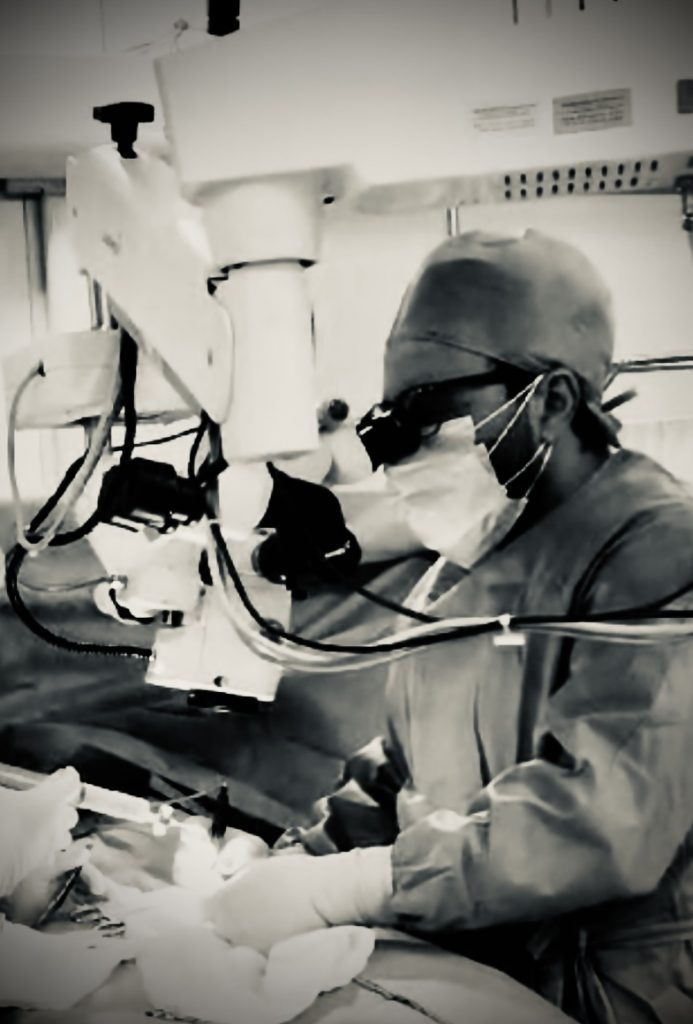
Microsurgery has recently been introduced into the field of urology and offers highly successful results. Using the magnification power of the surgical microscope the veins are more accurately visualized and easily controlled, while other vital structures are carefully preserved including the arteries and lymphatic vessels (lymphatic vessels are vascular channels draining fluids from the testis and hence their inadvertent ligation may lead to a condition called ‘Hydrocele’ which is collection of watery fluid around the testis).
MTESE is a surgical procedure that involves opening the testis and using the magnification offered by the surgical microscope, the seminiferous tubules are carefully studied. The surgeon will search for and retrieve the best-looking and healthiest tissues avoiding the removal of unnecessary testicular fragments and hence preserving the volume of the testis. Retrieved tissues are then sent for analysis and exploration for the presence of sperms to be used ultimately by assisted reproduction. This technique may result in higher success rates compared to other forms of testicular biopsy. Improved results are attributed to the magnification power offered by the surgical microscope that significantly improved sperm retrieval rates.
TESA/PESA is the simplest form of testicular biopsy, done as an outpatient procedure. It is performed using a needle that is connected to a syringe for aspiration, the surgeon will initially inject small dose of local anaesthetic into the skin overlying the testis and then insert a needle directly into the testis, and while the syringe is on the aspiration mode, tissues from within the testis are sucked through the needle. Tissue fragments aspirated from the testis are then pulled and collected in specific tubes for analysis. This is usually done at a facility where immediate examination of the tissues is possible.

LEARN MORE ABOUT MALE INFERTILITY SURGICAL TREATMENTS BY REQUESTING AN APPOINTMENT WITH DR. HUSSEIN KANDIL
PATIENT GUIDE · ABU DHABI & AL AIN
Male fertility procedures, explained clearly
Sperm retrieval and microsurgical varicocele repair with Dr. Hussein Kandil.
Different procedures solve different problems. Understanding whether sperm production is impaired or the transport pathway is blocked is an important part of choosing an approach.
Before choosing a procedure
Azoospermia means that no sperm are found in the ejaculate after appropriate laboratory assessment. It can result from a blockage despite ongoing sperm production, or from impaired production within the testes. These situations require different discussions.
Assessment may include repeat semen testing, examination, hormone results and selected genetic investigations. The partner’s fertility assessment and plans for IVF with intracytoplasmic sperm injection (ICSI) also influence timing and choices.
Retrieving sperm is a separate step from achieving pregnancy. Neither sperm retrieval nor a subsequent live birth can be guaranteed.
SURGICAL SPERM RETRIEVAL
Four approaches, different roles
TESA · Testicular sperm aspiration
A needle collects a small sample from the testis for laboratory examination. It may be considered when sperm production is preserved but sperm cannot reach the ejaculate.
TESA is different from a microscopic surgical search and is not the preferred approach for non-obstructive azoospermia.
PESA · Percutaneous epididymal sperm aspiration
A fine needle passes through the skin into the epididymis, the coiled structure beside the testis where sperm mature and are stored. Fluid is aspirated and checked for sperm.
PESA may suit selected cases of obstructive azoospermia. If an adequate sample is not obtained, another approach may be discussed.
MESA · Microsurgical epididymal sperm aspiration
Through a small incision, an operating microscope helps identify epididymal tubules. A tubule is opened and fluid is collected for the embryology laboratory.
MESA is an option in selected men with obstruction. Collected sperm may be frozen for future ICSI, depending on the sample.
microTESE · Microdissection testicular sperm extraction
For selected men with non-obstructive azoospermia, the surgeon examines testicular tissue under an operating microscope and samples selected tubules. The laboratory searches those samples for sperm.
Suitability depends on the evaluation, including relevant genetic findings. The procedure may find sperm in some men, but a successful retrieval is not assured.
VARICOCELE REPAIR
Subinguinal microsurgical varicocelectomy
A varicocele is an enlargement of veins around the testis. Repair may be considered in a man with a palpable varicocele, infertility and abnormal semen results, after considering the couple’s circumstances. An ultrasound finding alone does not automatically mean surgery is needed.
Through a small incision below the groin, the surgeon uses magnification to identify and tie off selected veins while aiming to preserve the testicular artery and lymphatic channels. Your teaching photographs show vein ligation with sutures.
Other options include observation or radiological embolisation in appropriate settings. Potential surgical risks include bleeding, infection, hydrocele, persistent or recurrent varicocele and, rarely, injury affecting the testis. Improvements in semen results or pregnancy are not guaranteed.
Questions to discuss before surgery
What are the alternatives?
Depending on the diagnosis, options can include observation, treating a specific medical cause, reconstructive surgery or assisted reproduction. The same operation is not appropriate for every cause of infertility.
What happens to retrieved sperm?
The embryology team assesses the sample. Suitable sperm may be used fresh or frozen for ICSI. The collection, freezing and treatment plan should be agreed with the fertility team beforehand.
What should I expect during recovery?
The operation, anaesthetic, work and activity restrictions, pain relief and follow-up plan vary. Ask for your own written instructions, including whom to contact for fever, increasing swelling or worsening pain.
Can testosterone change after testicular sperm retrieval?
A fall in testosterone is a recognised risk after testicular surgery, including microTESE. Baseline hormonal assessment and appropriate follow-up should be part of the discussion.
Arrange an individual assessment
Dr. Hussein Kandil consults in Abu Dhabi and Al Ain. Bring previous semen analyses, hormone results, genetic reports if available and a list of medicines and supplements. Please confirm the clinic branch and schedule when booking.
Medical background: AUA/ASRM male infertility guideline (2024) · EAU male infertility guidance. Page updated 25 October 2026.